Most people treat office chair weight capacity as a single number on a spec sheet. In real use, that number reflects how the chair’s frame, base, gas lift, and tilt mechanism handle load over time, not just a one-time “can it hold me” question.
A chair rated at 300 lb is not automatically better than a 250 lb chair. The rating depends on how the load is distributed through the structure, how dynamic movement is handled, and what durability testing the chair is designed to pass. If you choose by the number alone, you may end up with a chair that feels unstable when reclining, wears out early, or fails at the exact stress points that matter most in daily use.
This guide explains what office chair weight capacity really means, how it is tested, which parts carry the load, and how to choose the right capacity range without overbuying.
What office chair weight capacity means
Office chair weight capacity is the maximum recommended user weight a chair is designed to support during normal work use. It is intended to cover the real pattern of sitting, standing, rolling, and leaning that happens every day.
It is not the “instant break” number. A chair may survive above its rating for a short time, but repeated overload accelerates wear and increases the risk of failure at the base, cylinder, or tilt mechanism.
When the weight rating is accurate, it usually implies the chair has been engineered to maintain:
- Stability while seated and reclining
- Smooth tilt and height adjustment
- Structural integrity over repeated use
- A reasonable service life without loosening, wobble, or sudden failure
How weight capacity is tested in real product development
Responsible manufacturers use standardized durability and load testing to validate a rating. Testing typically includes both static and repeated-load scenarios.
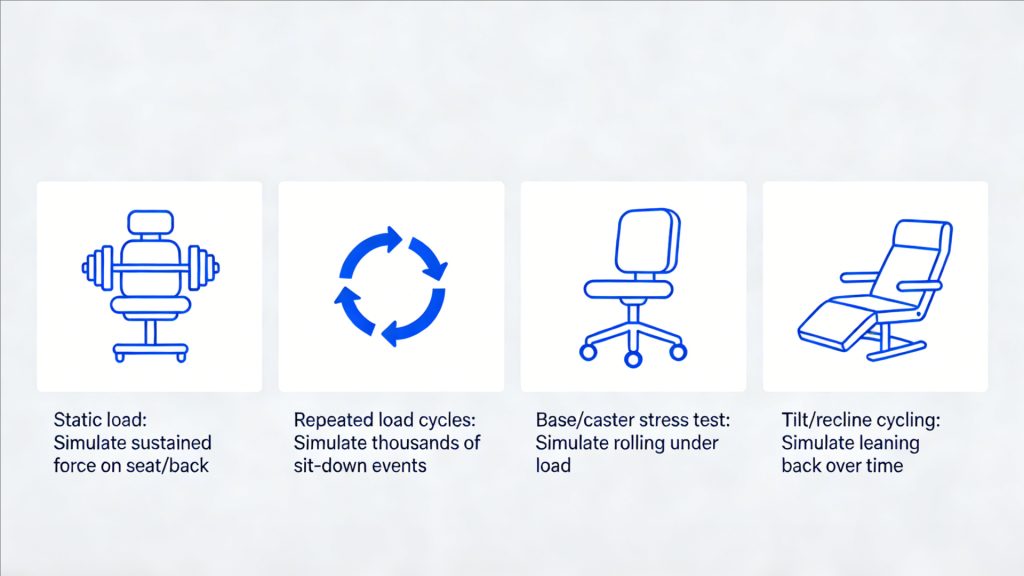
Common test categories include:
- Static load applied to the seat and back to simulate sustained force
- Repeated load cycles to simulate thousands of sit-down events
- Stress testing of the base and casters to simulate rolling under load
- Tilt and recline cycling to simulate leaning back over time
Why this matters: most failures do not happen when someone is sitting perfectly still. They happen when the user drops into the chair, shifts weight to one side, reclines, or rolls while seated. That is dynamic load, and it is often the difference between a chair that lasts and one that develops wobble fast.
A quick way to spot weak ratings
If a listing only states a number but provides no testing context, base material, cylinder class, or mechanism details, the rating may be marketing-first. A credible rating usually comes with at least some construction information.
The load path that determines weight capacity
Weight capacity is not carried by one part. It travels through a load path. The strength of the chair is limited by the weakest link.
The load path usually looks like this:
- User weight loads the seat surface
- Load transfers into the seat frame and mounting plate
- Load passes into the tilt mechanism
- Load transfers into the gas lift cylinder
- Load spreads into the base
- Load reaches the casters and floor contact points
If any part of this chain is underbuilt, the chair can fail even if other parts look solid.
The components that most affect weight capacity
Seat frame and mounting plate
A stronger chair starts with a rigid seat frame that spreads force evenly. A flexible seat pan concentrates stress at bolts and joints. Over time, that leads to looseness, squeaks, and eventual cracking.
What to look for:
- Reinforced metal or engineered composite frames
- Solid mounting points with minimal flex
- Hardware that does not look undersized
Tilt and recline mechanism
A chair can feel fine upright but become unstable when reclining because the load shifts backward and multiplies stress on the mechanism. Better mechanisms distribute force and resist twisting when the user leans or shifts.
Signs of better support:
- A stable tilt plate that does not rock side-to-side
- Smooth recline under load
- Firm lock positions that do not slip
Gas lift cylinder
The cylinder is a critical load-bearing component. Higher-capacity seating typically uses stronger cylinder designs with better seals, higher pressure tolerance, and improved long-term reliability.
Even if the seat is strong, a weak cylinder can lead to:
- Sudden sinking over time
- Height adjustment failure
- Instability when rotating or shifting weight
Base and caster geometry
Base design influences both strength and stability. A wider base improves anti-tip stability. Material quality matters because the base experiences high stress at the hub where the cylinder inserts.
What typically improves stability:
- Wider base diameter
- Reinforced materials
- Robust casters matched to the load
Weight capacity ranges and what they usually mean
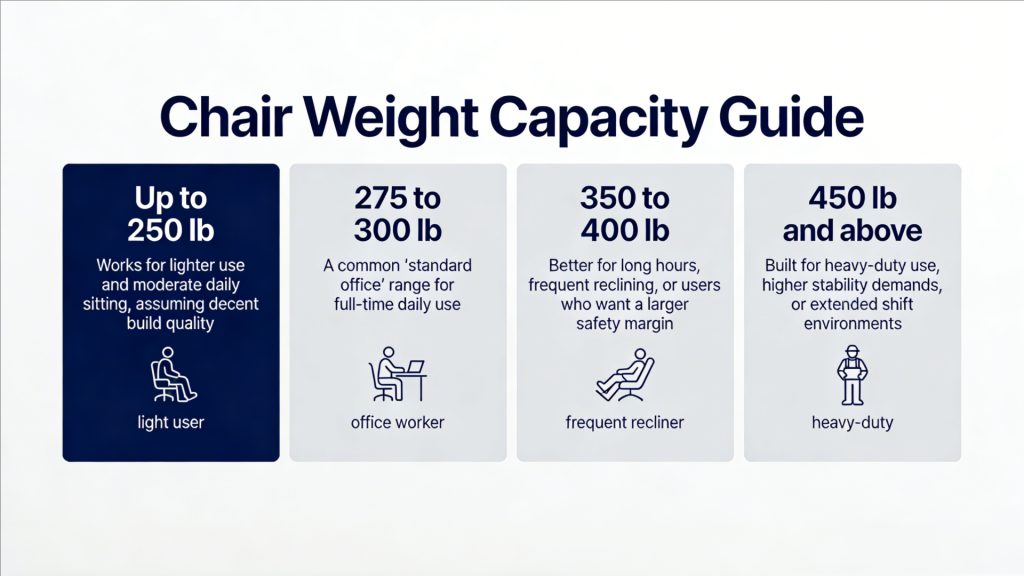
These ranges are practical buckets you can use during selection. The right choice depends on weight, hours of use, and how much reclining and movement is expected.
- Up to 250 lb
Works for lighter use and moderate daily sitting, assuming decent build quality. - 275 to 300 lb
A common “standard office” range for full-time daily use. - 350 to 400 lb
Better for long hours, frequent reclining, or users who want a larger safety margin. - 450 lb and above
Built for heavy-duty use, higher stability demands, or extended shift environments.
A simple rule that works well: choose a chair rating at least 50 to 100 lb above the user’s actual weight if the chair will be used daily for long hours.
Why weight capacity affects comfort and lifespan
Weight rating is often treated as a safety label, but it also predicts how a chair will feel after months of use.
When a chair is operating near its maximum rated capacity, it is more likely to:
- Lose seat cushioning support faster
- Develop play in the tilt mechanism
- Feel less stable when reclining
- Show early wear in the cylinder and base connection
A higher office chair weight capacity can improve long-term comfort because the structure resists flexing and maintains alignment under load. That makes lumbar support more consistent and recline behavior smoother.
When you should choose a higher capacity chair
You should consider moving up a capacity tier if any of the following are true:
- The user sits more than 6 to 8 hours per day
- The user reclines frequently or leans back hard
- The chair is shared by multiple people
- The chair needs a longer replacement cycle
- The chair is used in high-activity environments where users shift and move often
If the environment is demanding, it is usually cheaper long-term to buy a chair that is not operating near its limit every day.
Myths that lead to bad decisions
Higher weight capacity always means a bigger chair
Not always. Some chairs increase capacity through internal reinforcement and stronger mechanisms while keeping standard proportions.
Exceeding capacity slightly is harmless
The problem is not one moment. It is repeated stress. Consistent overload shortens service life and increases failure risk.
Weight capacity equals comfort
Capacity supports safety and durability. Comfort still depends on fit and adjustability such as seat depth, lumbar support, armrest positioning, and back support shape.
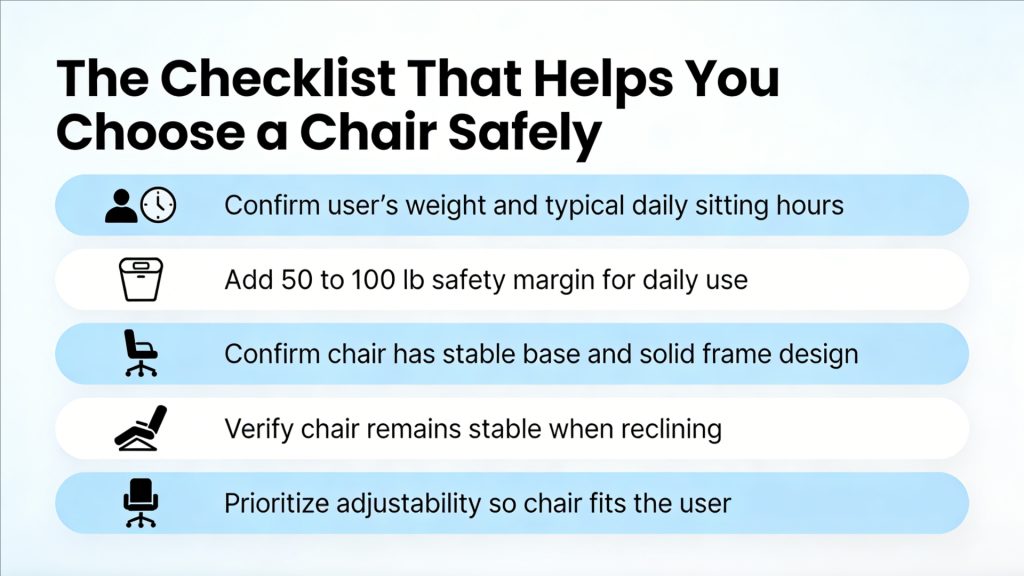
The checklist that helps you choose safely
Use this decision order to avoid overbuying and underbuying:
- Confirm the user’s weight and typical daily sitting hours
- Add a 50 to 100 lb safety margin for daily use
- Confirm the chair has a stable base and solid frame design
- Verify the chair remains stable when reclining
- Prioritize adjustability so the chair fits the user, not just supports the weight
This approach is more reliable than shopping by the weight number alone.
FAQ about office chair weight capacity
Does office chair weight capacity include movement and reclining
A meaningful rating should reflect normal movement such as shifting, rolling, and reclining. Dynamic load is often what damages weak mechanisms, so testing and structure matter more than the number alone.
Is a higher weight capacity chair always safer
Higher capacity generally improves safety margin, but only if the construction is balanced across the load path. A high number without strong base and mechanism design can still feel unstable.
What happens if I exceed the weight capacity
The chair may not fail immediately, but repeated overload increases the chance of cylinder sinking, base stress cracking, tilt looseness, and instability over time. The biggest risk often appears during recline or side-loading movements.
How much extra capacity should I choose
For daily use, a 50 to 100 lb margin is a practical buffer. If the chair is used for long hours or frequent reclining, choose the higher end of that margin.
Can two chairs with the same rating feel very different
Yes. One chair may distribute load well and remain stable when reclining, while another may flex and wobble due to a weaker mechanism or base geometry. The rating is only one piece of the durability story.
Conclusion
Office chair weight capacity is not just a label. It is a practical signal of how the chair’s frame, mechanism, cylinder, and base handle real-world stress over time. The safest way to choose is to understand the load path, account for dynamic movement, and select a capacity range that includes a sensible margin.
When you match office chair weight capacity with the right structure and adjustability, you get a chair that stays stable, comfortable, and reliable for years instead of months.