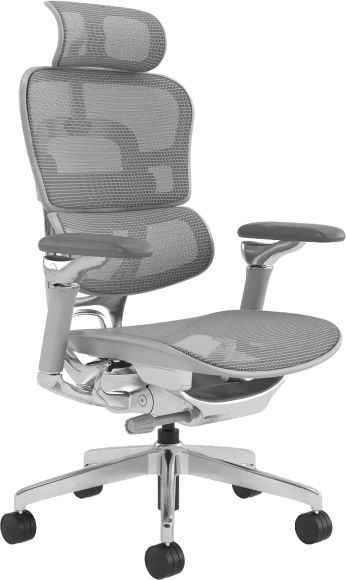
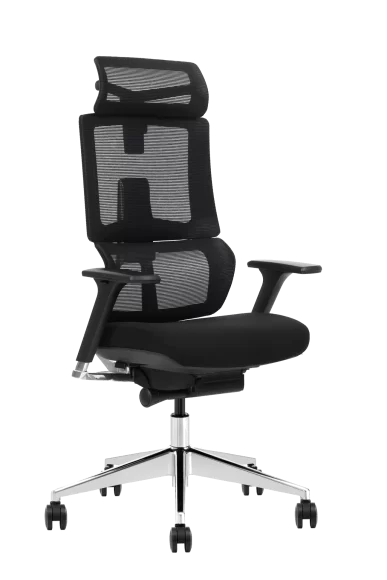
If your team sits at desks for a normal 8-hour day, a task chair is almost always the right answer. Executive chairs make sense for managers who spend more time in meetings than at a keyboard, and operator chairs (sometimes called 24/7 chairs) are built specifically for shift environments like call centers, dispatch, and control rooms. Choose the wrong category and you’ll either overpay for features nobody uses — or underspec and replace chairs every 18 months.
The Three Categories, Defined Properly
The labels get thrown around loosely, but the engineering behind each chair is genuinely different. It’s not just a marketing tier.
Task chair
A mid-back, highly adjustable chair built for one person doing focused desk work for around 8 hours a day. Mesh or fabric, synchro-tilt mechanism, adjustable armrests, lumbar support. Designed to disappear under the user — you shouldn’t notice it.
Executive chair
A high-back chair with a headrest, usually upholstered in leather or PU leather, designed to project authority. The mechanism is often simpler (a basic tilt-lock) because the user spends less continuous time in it. Padding is plusher; adjustability is usually lower.
Operator chair
Engineered for 24/7 multi-shift use. Reinforced base (often 5-star aluminum instead of nylon), heavy-duty Class 4 gas lift, fabric chosen for breathability and durability over multiple users, and BIFMA or EN 1335 certification at the higher cycle counts. The same chair gets sat in by three different people across three shifts — so it has to handle that.
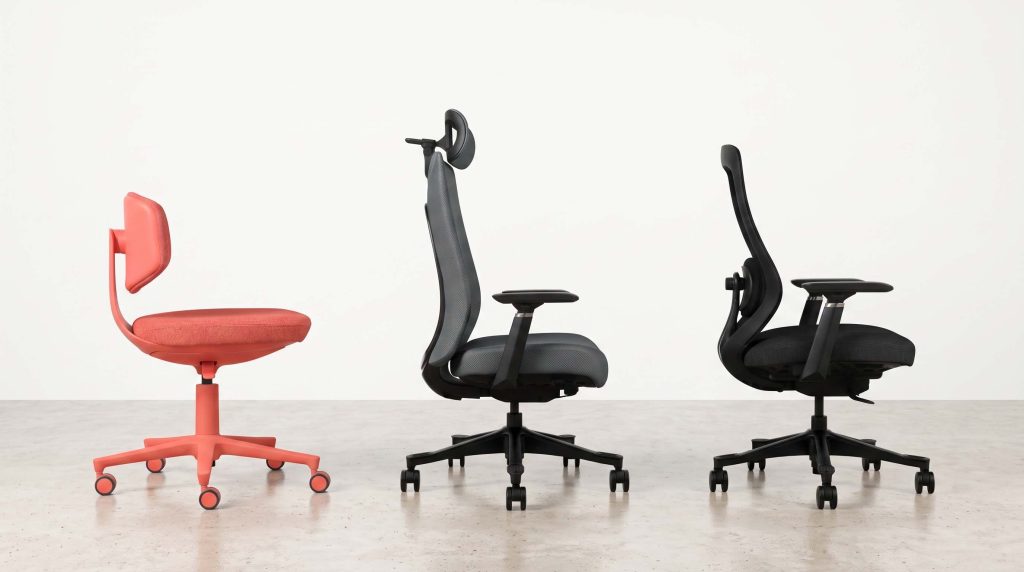
Quick Comparison: How They Stack Up
Before we dig into use cases, here’s the side-by-side. Save this if you’re speccing for a mixed office.
| Criteria | Task Chair | Executive Chair | Operator Chair |
|---|---|---|---|
| Typical daily use | 6–8 hours | 2–5 hours | 16–24 hours |
| Best user | General desk staff | Managers, directors | Call center, control rooms |
| Backrest height | Mid-back | High-back with headrest | Mid-back, reinforced |
| Upholstery | Mesh or fabric | Leather or PU leather | Heavy-duty fabric/mesh |
| Weight capacity | 110–130 kg | 120–150 kg | 130–180 kg |
| Warranty cycle rating | 5 years / 8h use | 5–10 years / light use | 5+ years / 24h use |
| Price range (USD) | $120–$400 | $300–$1,200 | $250–$700 |
| Adjustability | High | Medium | Very high |
Notice that operator chairs aren’t always the most expensive — but they’re almost always the most over-engineered for the hours they have to survive. For a deeper look at how chair categories overlap, see our breakdown of task chair vs office chair differences.
Task Chairs: The Workhorse for 80% of Offices
If you’re outfitting a normal office where people code, write, design, or process — buy task chairs. Full stop.
The task chair category exists because most office work isn’t glamorous. It’s typing, scrolling, and the occasional video call. What you need: a chair that adjusts to a 5-foot-2 user and a 6-foot-4 user equally well, has lumbar support that actually catches your lower back (not just a marketing bump), and a synchro-tilt that lets you recline without your feet leaving the floor.
What to look for
- Seat depth adjustment (slider) — critical for taller and shorter users sharing chair models
- 3D or 4D armrests — height, width, depth, and pivot
- Mesh back with adjustable lumbar height (not fixed)
- Class 3 or Class 4 gas lift, BIFMA-certified
- Seat height range of at least 42–52 cm to fit different desk heights
For example, a SaaS company we worked with replaced 80 generic fabric task chairs with mid-tier mesh task chairs at around $280 each. Six months later, their HR team logged a 40% drop in “back pain” comments in quarterly surveys. The chairs weren’t fancy — they just fit. Compare materials in our mesh vs foam office chairs guide if you’re torn between the two.

Executive Chairs: When Looks Actually Matter
Here’s the unpopular truth: executive chairs are partly furniture, partly status object. And that’s fine — as long as you’re buying them for the right reason.
An executive chair makes sense when the user spends most of the day in meetings, on calls, or hosting clients in their office. The high back and headrest support a more reclined, relaxed posture. The leather upholstery photographs well and ages with character. The plush padding feels premium during a 90-minute board meeting.
Where executives go wrong: buying a leather throne for a director who actually codes 7 hours a day. Leather doesn’t breathe. The fixed lumbar position fights you when you lean in to work. The heavy padding compresses unevenly after 18 months of daily heads-down use. If your “executive” is really a power user, get them a high-end task chair instead.
Real scenario
A law firm partner sees clients three days a week and drafts contracts the other two. The right answer here is actually two chairs — a leather executive chair in their client-facing office, and an ergonomic task chair in the back room they use for deep work. Splitting the function across two chairs is cheaper than buying one chair that does neither well.
For materials, our guide to PU leather explains why mid-tier executive chairs use PU instead of full-grain — and when that’s actually fine.
Operator Chairs: Built for the Hardest Job in Seating
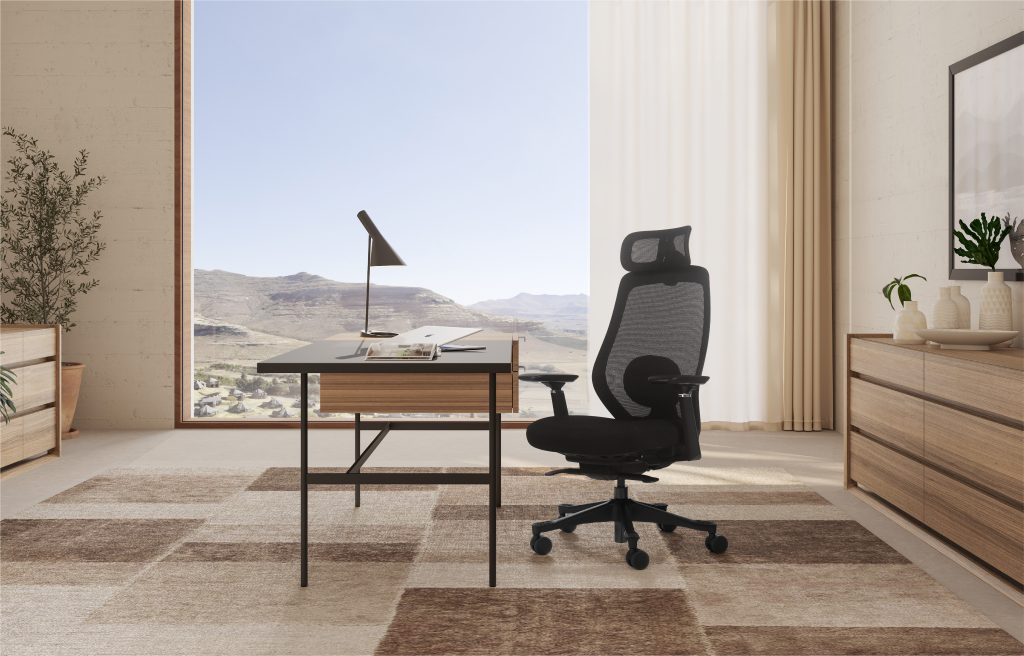
Operator chairs are the unsexy heroes of the seating world. And they’re the category most often spec’d wrong.
If you run a call center, NOC, dispatch room, trading floor, or any environment where the chair never gets a break — you cannot use a standard task chair. The mechanism will fail. Cycle ratings on consumer task chairs typically assume one user for 8 hours a day, 5 days a week. An operator chair sees three users, 24 hours a day, 7 days a week. That’s roughly 4x the wear.
What separates a real operator chair
- BIFMA X5.1 or EN 1335 Type A certification at the 24/7 cycle level
- Class 4 gas lift rated for 250,000+ cycles (vs 80,000 for consumer)
- Aluminum 5-star base (nylon cracks under continuous heavy use)
- Mechanism rated for 120,000+ tilt cycles minimum
- Fabric chosen for cleanability — multiple users mean more contamination
- Higher weight capacity (often 150 kg+) because you can’t predict who sits in it next
For instance, a 200-seat call center we supplied switched from $180 task chairs to $420 operator chairs after their warranty replacement rate hit 22% in year one. The new chairs are now in year three with a 3% replacement rate. The math worked out within 14 months. For more on this, see our piece on why office chair weight limits matter — operator environments are where it bites first.

Mixing Categories in One Office: A Practical Allocation
Most offices need a mix. Here’s a realistic allocation for a 100-person company.
- 75–85 task chairs for general staff at $200–$350 each
- 5–10 executive chairs for C-suite and senior managers at $500–$900 each
- 10–15 operator chairs if you have a customer support team running extended hours, at $350–$500 each
- 2–4 visitor/meeting chairs per conference room — separate budget line
The mistake we see constantly: buying executive chairs for everyone in management. A team lead who spends 7 hours a day on Slack and Figma needs a task chair, not a leather throne. Save the executive chairs for people whose role is actually customer-facing or representational.
If you’re planning a full layout, our notes on common office space planning mistakes cover the seating-density issues that catch buyers off guard.
What These Chairs Cost Over 5 Years (Not Just Day One)
Day-one price is the wrong number to optimize. Total cost of ownership is what kills budgets.
A $150 task chair that fails in 18 months costs you $500 over five years (initial + replacement + replacement + assembly labor). A $300 task chair that lasts 7 years costs you $300 over the same period. The cheaper chair is 67% more expensive.
For operator chairs, the gap is even sharper. A consumer-grade chair in a 24/7 environment lasts 8–14 months. A proper operator chair lasts 4–6 years. At 100 seats, the math difference is in the tens of thousands.
Executive chairs are the one place where you’re partly buying perception, so cost-per-year is less of the story. But even there — a $1,200 chair that creaks after 2 years undermines the very impression you paid for. We covered the durability math in detail in our office chair lifespan guide.
Red Flags When Suppliers Blur the Categories
Some manufacturers will sell you a dressed-up task chair as an “executive” model, or a regular task chair as “24/7 ready.” Watch for these:
- “Executive” chairs under $200. Real leather or even quality PU plus a high-back frame can’t hit that price point. It’s a task chair with a headrest glued on.
- “Heavy duty” with no cycle rating. If the spec sheet doesn’t list BIFMA or EN 1335 cycle counts, assume it’s a consumer chair.
- Plastic 5-star base on an “operator” chair. Disqualifying. Aluminum only for 24/7.
- No weight-capacity certification. The number on the box is meaningless without third-party testing.
- Vague warranty language. “5-year warranty” means nothing without specifying components and use hours. A real warranty defines what’s covered for what use intensity.
If you’re shopping by spec sheet, our list of 25 office chair ergonomics facts will help you spot which numbers actually matter.
How to Decide in Under Five Minutes
Three quick questions get you to the right category 95% of the time.
- How many hours a day will the chair be used by one person? Under 4: executive is fine. 4–9: task chair. 9+ or multi-shift: operator chair.
- Does the role involve hosting clients in that office? Yes: lean executive. No: lean task or operator.
- Is the user heads-down focused, or in meetings/calls? Heads-down: task chair every time, even for senior staff. Meetings/calls: executive can work.
That’s it. Don’t overthink it.
At Vaseat, we manufacture all three categories and ship to clients across 60+ countries — from boutique offices ordering 20 task chairs to call center groups speccing 2,000 operator seats. If you’re trying to figure out the right mix for a specific project, browse our full product range or get in touch via the about page. We’ll tell you honestly when you’re overspending — and when you’re underspeccing for the job.