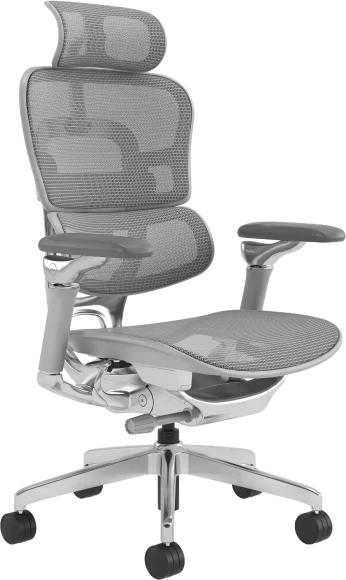
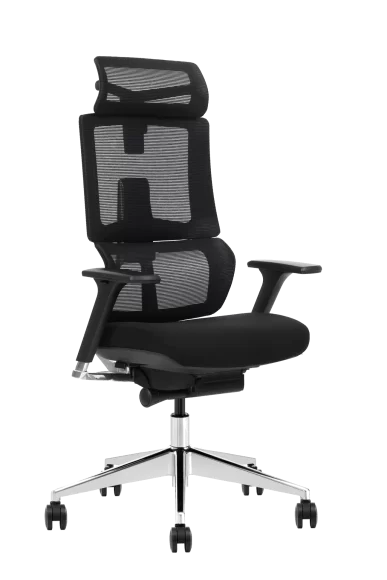
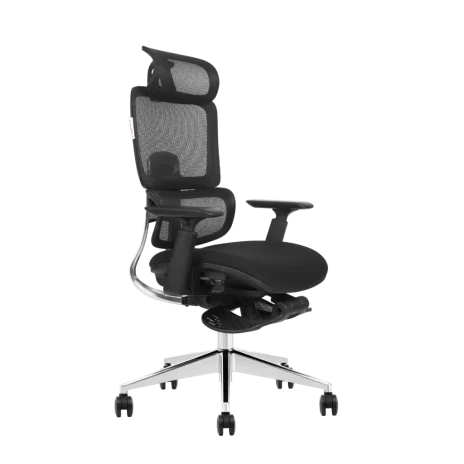
A proper office chair factory audit in 2026 comes down to three things: verifying the factory actually makes what it claims to make, confirming the test reports match the units rolling off the line, and pressure-testing the supplier’s QC system before you commit to a PO. Skip any of those and you’re not auditing — you’re touring. This guide walks through exactly what a procurement manager should inspect, ask, and document during a China factory visit or remote audit, with the specific red flags that separate a serious OEM manufacturer from a trading company wearing a factory’s clothes.
Before You Book the Flight: Pre-Audit Verification
Most failed sourcing projects fail before the buyer ever lands in Guangzhou. The first 80% of an audit happens at your desk.
Pull the supplier’s business license from the National Enterprise Credit Information Publicity System (国家企业信用信息公示系统). You’re checking three things: registered capital (a real chair factory typically shows 5M RMB+), business scope (it must explicitly list furniture manufacturing — not just “sales” or “trading”), and registration date. A factory registered in 2023 claiming 15 years of OEM experience is not a factory.
Next, request three documents up front: a recent BIFMA or EN 1335 test report, a factory layout drawing, and a list of mechanism and gas lift suppliers they use. Serious manufacturers send these within 48 hours. Trading companies stall, ask why you need them, or send reports where the chair model number doesn’t match anything in their current catalog.
The Google Earth Test
Pull up the factory address on satellite view. You’re looking for the actual building footprint. A 12,000 m² factory shows up as a 12,000 m² factory. If the registered address points to an apartment block, a small office park, or a warehouse cluster with no visible loading bays, you’re dealing with a sourcing agent.

Walking the Production Floor: What to Actually Look At
Forget the showroom. The truth lives on the production floor.
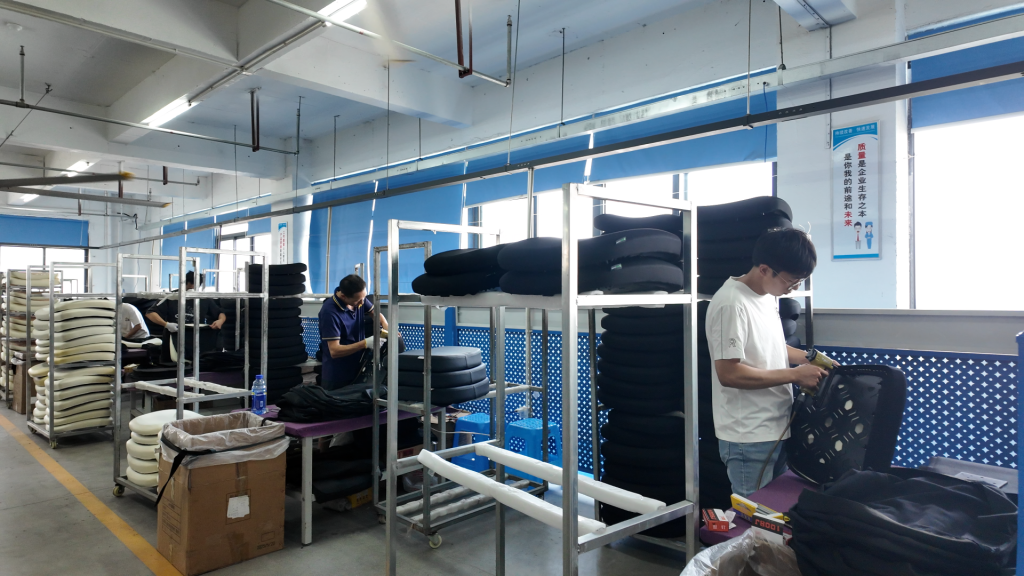
Start at the welding station for chair bases and frames. Look for jig-based welding setups, not freehand workers eyeballing joints. Ask to see the weld inspection log — every serious factory keeps one. Then move to the foam molding area. Cold-cure molded foam (the kind that lasts 8+ years under daily use) requires steel molds and a curing line. If you only see cut block foam being glued together, that chair will compress within 18 months. We’ve covered why that matters in our guide to chairs built for all-day sitting.
Watch the mesh tensioning station closely. The operator should be using a calibrated jig to pull the mesh to a specified tension before heat-sealing or clip-fixing. If they’re tensioning by feel, every chair in your container will sit differently.
The Five Stations You Must See
- Tube cutting and welding: Look for CNC pipe-bending machines and welding jigs.
- Powder coating line: A real line has pre-treatment tanks, electrostatic spray booths, and a curing oven — not a guy with a spray gun in an open shed.
- Foam injection or cutting: Confirm density measurement tools on site.
- Mesh and upholstery: Tension jigs, not eyeballed work.
- Final assembly and QC: A dedicated inspection station with torque wrenches and a load tester.
A real-world example: one European distributor we know walked into a “factory” in Anji and found a clean showroom, a small assembly bench, and a back door leading to a courtyard where unbranded chairs arrived on flatbeds from three different suppliers. That’s not a factory. That’s a repackaging operation.
Decoding Test Reports: BIFMA, EN 1335, and GB/T
If a factory hands you a test report and you nod politely, you’ve already lost the audit. Test reports must be cross-checked.
The three reports you’ll see most often in China:
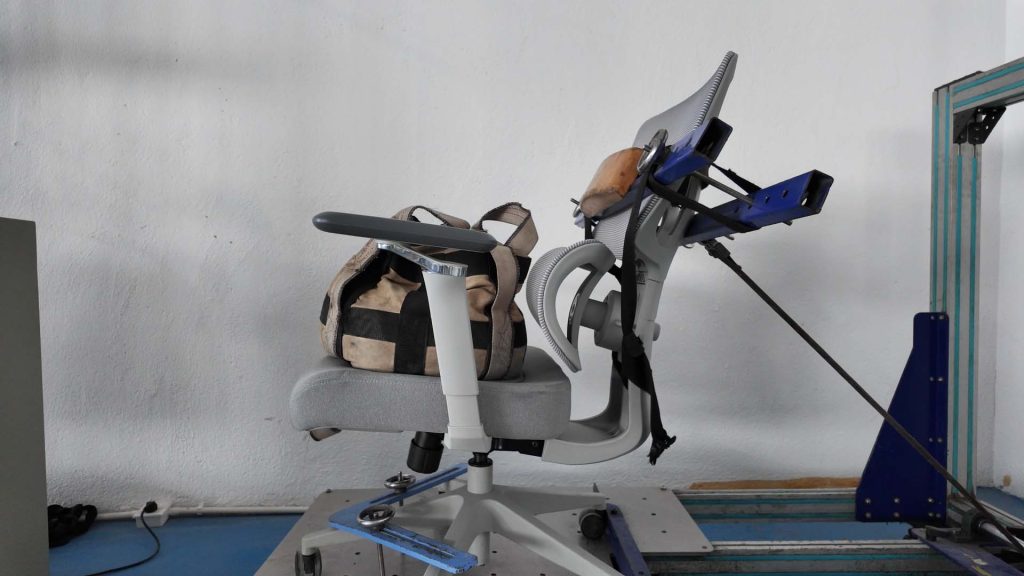
- BIFMA X5.1 — North American commercial standard. Covers backrest durability (120,000 cycles), seat impact, and stability.
- EN 1335-2/3 — European standard. Mandatory for most EU public tenders. Defines safety and durability requirements.
- GB/T 3324 — Chinese national standard for wooden and metal-frame office chairs.
Here’s what to verify on every report: the lab name (SGS, TÜV, Intertek, and Bureau Veritas are the names you want to see), the issue date (older than 3 years means re-test), the chair model number (must match a current production SKU), and the photograph of the tested unit. That last one trips up most fakes — fraudulent reports rarely match photos to the real chair.
For a deeper breakdown of which standard actually applies to your market, see our guide on the 10 key factors before you buy. And before you accept any weight rating claims, read why office chair weight limits matter — factories regularly overstate this without independent verification.
Trading Company or Real Factory? The Comparison That Matters
Knowing who you’re actually buying from changes everything — pricing, lead times, custom tooling, and accountability when something goes wrong. The table below summarizes how the three supplier types compare in practice.
For project buyers spec’ing 500+ chairs with custom armrests, mesh colors, or branded backrests, only vertically integrated factories can deliver without a chain of finger-pointing when something goes wrong. For mid-volume standard models, a focused OEM is often the sharpest commercial choice. Trading companies have their place — small mixed-product orders or test runs — but they should never own a project tender.
The QC System: What Separates a 1% Defect Rate from a 7% One
Every factory claims a 1% defect rate. Almost none of them measure it correctly.
Ask to see the QC inspection sheet for the last completed export order. A real document has serial numbers, inspector signatures, defect codes, and rework tracking. If they show you a blank form template, walk away. Then ask the practical follow-up: what happens to a chair that fails the final test? In a real factory, it gets a red tag, goes to a rework station, and is logged in a database. In a weak one, it gets quietly pushed back onto the line.
The Four QC Stages Worth Checking
- IQC (incoming): Gas lifts, casters, mesh rolls, and foam blocks tested on arrival. Class 4 gas lifts are the minimum for commercial use.
- IPQC (in-process): Torque checks on every assembly station.
- FQC (final): 100% functional test — every chair sat in, rolled, tilted, and height-adjusted before packing.
- OQC (outgoing): Random pull from packed cartons, re-tested.
A practical example: a Middle East distributor placed a 1,200-unit order with a factory that skipped IPQC torque checks. Forty percent of chairs arrived with loose seat-plate bolts that worked their way out within three months. The factory’s QC sheets looked fine on paper — they just didn’t reflect what was happening on the line.
Component-Level Sourcing: The Questions That Reveal the Truth
A chair is the sum of its components. Asking about each one tells you exactly how serious a factory is.
Gas Lifts
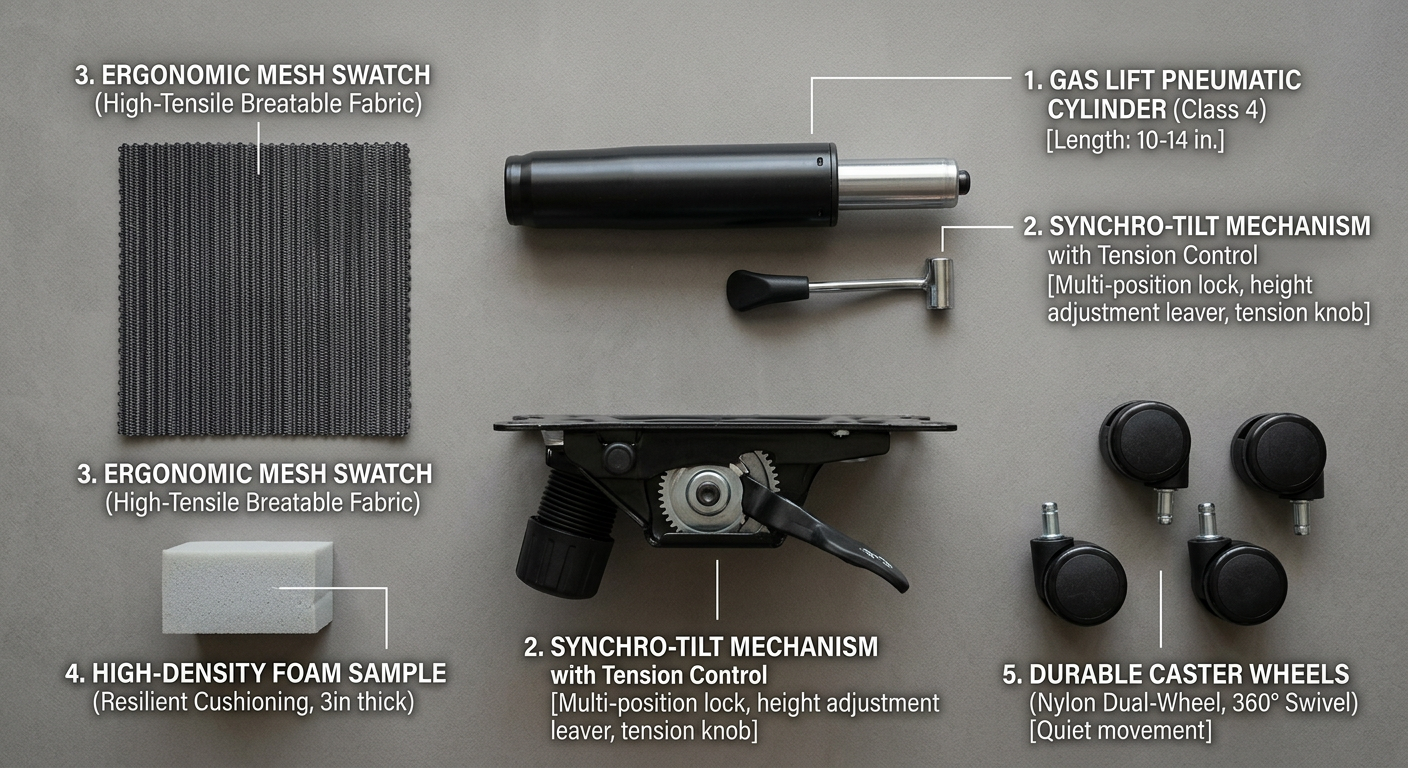
SGS-certified Class 4 minimum for commercial chairs. Ask which brand — Samhongsa, Suspa, and Stabilus are the premium tier; KGS and several reputable Chinese suppliers are the workhorse tier. If they can’t name the brand, they’re buying market-floor stock and your warranty risk skyrockets. Cheap gas lifts are the #1 reason desk chairs keep sinking within the first year.
Mechanisms
Synchro-tilt and multi-functional mechanisms should carry their own BIFMA cycle test. Ask for the report. A good mechanism survives 120,000 cycles minimum; a budget one fails at 30,000.
Mesh
Korean mesh, US-made mesh, and top-tier Chinese mesh (Matrex, JFA) are the brands worth specifying. Ask for the mesh tension spec in N/cm and the elongation recovery rate. If the factory shrugs, the mesh is generic.
Casters
65mm PU-coated casters for hard floors, 60mm nylon for carpet. The factory should know the load rating per caster (typically 35–50 kg).
Foam
Density matters more than thickness. Molded foam at 45–55 kg/m³ holds shape for years. Cut foam at 28–32 kg/m³ collapses fast.
Remote Audits and Third-Party Inspectors in 2026
You don’t always need to fly. A well-run remote audit can cover 80% of what an in-person visit would catch — if you structure it right.
Hire a third-party agency (SGS, QIMA, Asia Inspection, or a regional independent) to do the on-site work. Brief them with a specific checklist: count production lines, photograph each station, capture the QC inspection sheet from the most recent order, and pull serial numbers from finished goods inventory to cross-check against the test report you received. Expect to pay $300–$600 USD per audit day in 2026 — cheap insurance on a $50,000+ order.
Then run a live video walkthrough yourself. Schedule it during production hours, not lunch. Have the supplier walk the floor camera-first, not face-first. If the camera mysteriously points at the ceiling when passing certain stations, that’s your answer.
The Five-Minute Video Test
Ask the supplier to film, in one continuous shot, the path from raw tube stock to packed carton. A real factory can do this in 5–8 minutes. A trading company can’t — because the path doesn’t exist.
Red Flags That Should End the Conversation
Some warning signs aren’t worth negotiating around. They’re terminal.
- Refusing to share the factory address until after PO. No legitimate manufacturer hides this.
- Test reports with mismatched model numbers. Either fraud or sloppiness — both are deal-killers.
- Sample chair differs from production unit in foam density or mesh tension. Classic bait-and-switch.
- Insistence on 50%+ deposit with no LC option on orders over $30,000. Healthy factories accept reasonable payment terms.
- No willingness to put penalty clauses in the contract for QC failures. If they won’t stand behind their chairs, you shouldn’t either.
- Different chair brands appearing in “their” showroom photos across the internet. Reverse-image search every showroom photo before signing anything.
Lifespan, durability, and ergonomic integrity are not negotiable on commercial seating. If you’re spec’ing chairs that will be sat in 8 hours a day for 5+ years, the audit standards have to match. Our guide on how long an office chair actually lasts covers what realistic lifespan claims look like by component.
Building a Long-Term Supplier Relationship After the Audit
The audit isn’t the finish line. It’s the start of a relationship that — if managed well — gets cheaper, faster, and lower-risk every year.
After your first successful order, set up a quarterly review: defect rate, on-time shipment percentage, response time on technical questions, and any spec changes. Share forecast volumes 6 months ahead — factories prioritize buyers who give them planning visibility. In return, ask for component-level price breakdowns once your annual volume crosses $200,000. That single document gives you negotiating leverage forever.
For project buyers running multiple tenders a year, lock in framework pricing with the top one or two factories from your shortlist. That way when an architect calls Tuesday asking for 380 task chairs delivered to Dubai by quarter-end, you already know your cost, lead time, and quality risk. Pair that with a solid grasp of how to choose an ergonomic chair for the end use, and you’ll be ahead of 90% of distributors still bidding blind.
Your Practical Next Steps
A solid factory audit in 2026 is methodical, not heroic. Verify the business license. Walk five specific stations. Cross-check test reports against the production unit. Ask about every major component by brand and spec. Run a third-party inspector or live video walkthrough. End the conversation early when the red flags are real.
Do that consistently and your defect rates fall, your lead times tighten, and your project margins stop bleeding out on warranty claims. As a manufacturer of ergonomic mesh chairs, task chairs, drafting chairs, and visitor seating built for commercial and project use, we welcome the kind of detailed scrutiny outlined above — feel free to request our latest test reports, walk our line by video, or send your inspector. Serious buyers and serious factories work better together.