A cheap office chair doesn’t save money — it redistributes the cost into warranty headaches, frequent replacements, and employee back pain that quietly erodes productivity. When you factor in the full lifecycle, a $90 budget chair can cost two to three times more than a quality ergonomic seat purchased once. This article breaks down exactly where that hidden money goes, backs it up with real numbers, and shows you how to make purchasing decisions that actually protect your bottom line.
The Illusion of Savings: Why Low Price Tags Lie
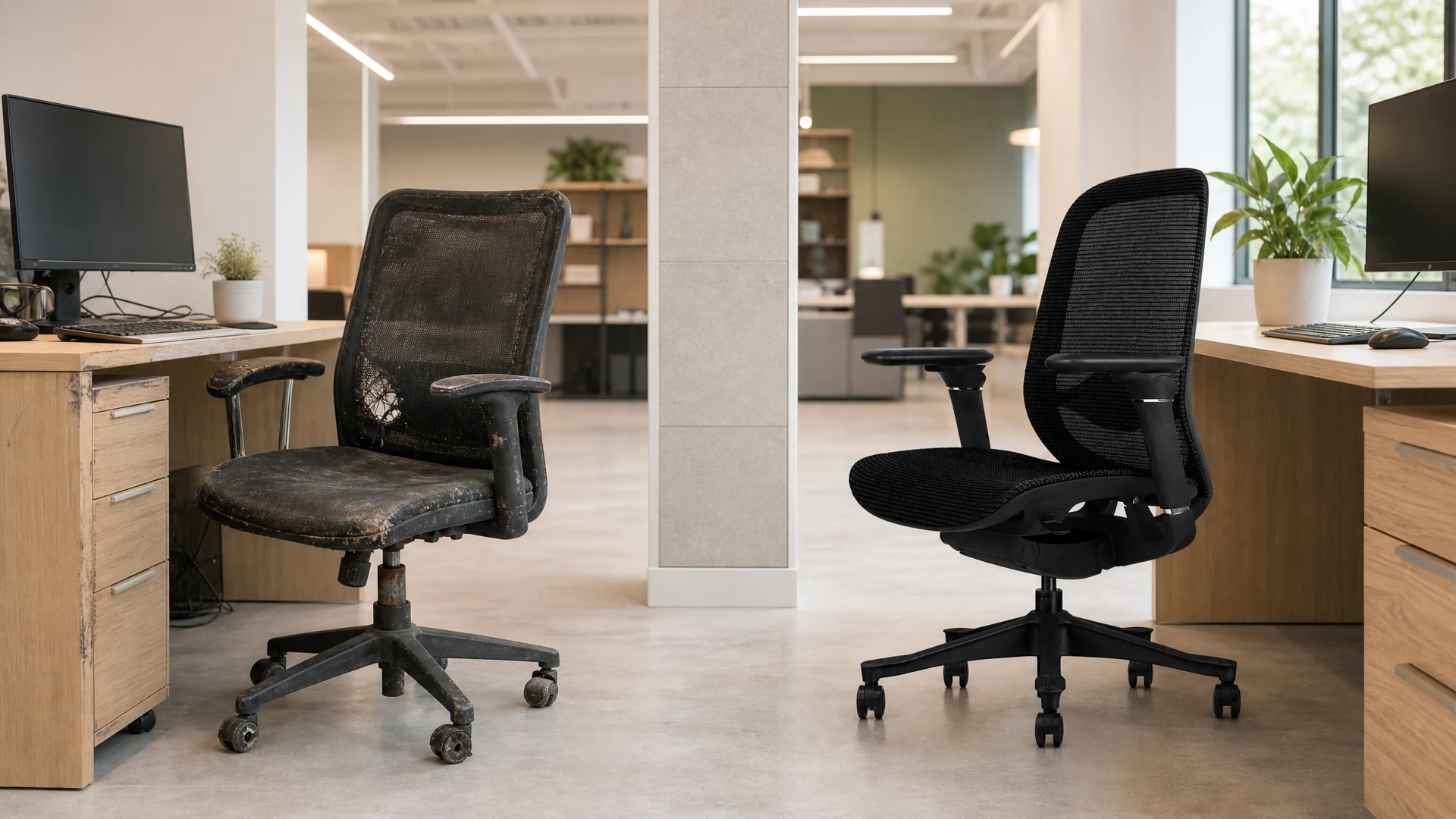
Here’s a number that should make any procurement manager pause: the average budget office chair lasts 1.5 years under daily 8-hour use. A quality ergonomic chair? Eight to twelve years — sometimes longer. That means over a decade, you’re buying five to seven cheap chairs for every one good chair you could have purchased upfront.
The math is brutal. Say you outfit 50 workstations with $100 chairs. That’s $5,000 — looks great on this quarter’s budget. But within 18 months, gas cylinders start failing, armrests crack, seat foam compresses into a pancake. By year three, you’ve replaced half the fleet. By year ten, you’ve spent $25,000–$50,000 on the same 50 seats. A single purchase of quality chairs at $600 each would have cost $30,000 — once — with most still in service.
The sticker price is not the cost. The total cost of ownership is the cost. And cheap chairs have the worst total cost of ownership of any office furniture category.
Warranty Claims: The Administrative Black Hole
Most budget office chairs come with either no warranty or a vague 1-year limited warranty that covers almost nothing useful. And even when a claim is technically valid, the process itself is a hidden cost that almost nobody accounts for.
What a Single Warranty Claim Actually Costs
Think about the chain of events when one cheap chair breaks. An employee reports the issue. A facilities manager inspects it, photographs it, files a claim. They wait for a response — often days. A replacement part may ship from overseas, taking weeks. Meanwhile, the employee either sits in a broken chair or borrows someone else’s. If the claim is denied (common with budget brands), someone has to argue or just order a new chair anyway.
Conservative estimate: each warranty claim consumes 2–4 hours of staff time across departments. At a blended labor cost of $35/hour, that’s $70–$140 in administrative cost per claim — on a $100 chair. If 30% of your budget fleet fails in year two (a realistic failure rate for sub-$150 chairs), and you have 200 seats, that’s 60 claims generating $4,200–$8,400 in pure administrative waste.
The Warranty You Should Actually Look For
Reputable manufacturers back their chairs with 10–15 year warranties covering the frame, mechanism, and gas cylinder — the components that actually break. Before purchasing, check if the manufacturer holds recognized quality certifications like BIFMA, ISO 9001, or EN 1335. These aren’t marketing badges; they indicate the chair was tested to withstand tens of thousands of use cycles before it ever reached your office.

Replacement Frequency: The Revolving Door of Disposable Seating
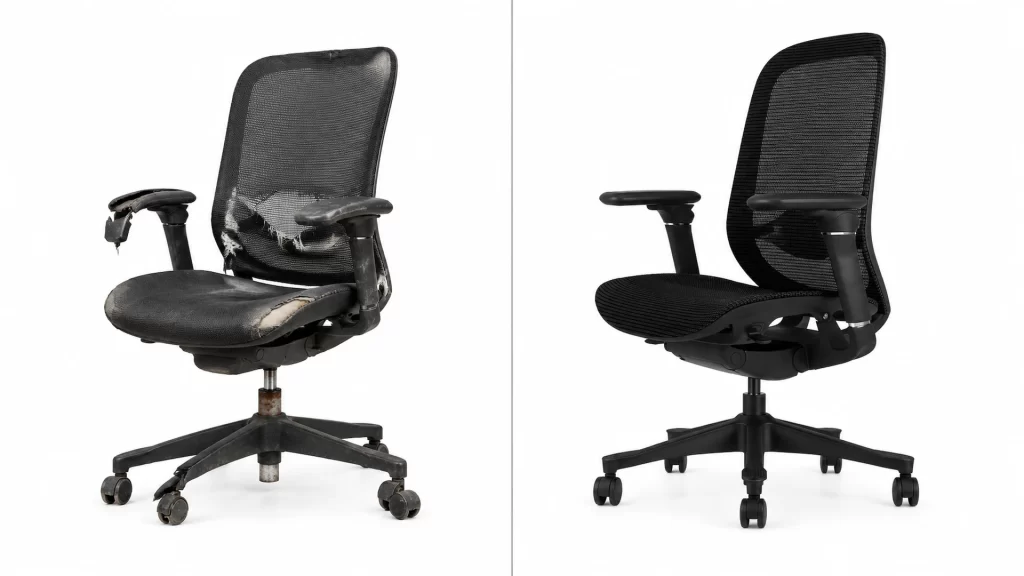
Budget chairs aren’t designed to be repaired. They’re designed to be replaced. That’s not cynicism — it’s engineering reality. When a manufacturer uses injection-molded nylon instead of reinforced glass-fiber or aluminum for the chair base, they’ve already decided the chair has a 2-year expiration date.
The key structural components of a chair — the base, gas lift, tilt mechanism, and casters — determine its functional lifespan. In cheap chairs, these are the first things to fail, and they’re usually proprietary or non-standard, making replacement parts impossible to source.
A Real-World Example: The Co-Working Space Trap
A mid-sized co-working operator in Southeast Asia furnished 300 hot desks with $85 mesh task chairs in early 2024. By mid-2025, 40% had visible issues: sagging mesh seats, wobbly bases, non-functional tilt locks. The operator spent $11,000 replacing 120 chairs — nearly half the original purchase price — in just 18 months. They’ve since begun phasing in commercial-grade ergonomic seating and project the new chairs will last through 2032 without major replacements.
Replacement isn’t just a financial cost. It’s logistical disruption: procurement cycles, delivery coordination, old-chair disposal, and the environmental waste of sending 120 chairs to landfill every year and a half.
Lost Workdays: The Cost Nobody Puts on a Spreadsheet
This is the biggest hidden cost of all, and it’s the one most companies completely ignore because it doesn’t show up on a furniture invoice.
Musculoskeletal disorders (MSDs) are the leading cause of workplace absenteeism in office environments. The U.S. Bureau of Labor Statistics reports that MSD cases require a median of 14 days away from work. The Occupational Safety and Health Administration (OSHA) estimates that MSDs cost employers $20 billion annually in direct workers’ compensation costs alone — and up to $100 billion when indirect costs like lost productivity and replacement labor are included.
How a Bad Chair Creates a Sick Day
A chair without proper lumbar support forces the spine into a C-curve. Within weeks, this leads to chronic lower back tension. Within months, it can progress to disc compression, sciatica, or SI joint dysfunction. An employee doesn’t call in sick because of a chair — they call in sick because of the back pain the chair caused.
The average cost of one lost workday in the U.S. is roughly $300–$500 when you factor in salary, lost output, and coverage. If poor seating causes even two additional sick days per employee per year across a 100-person office, that’s $60,000–$100,000 in lost productivity. That dwarfs the price difference between budget and quality chairs.
Presenteeism: The Invisible Drain
Worse than absenteeism is presenteeism — employees who show up but work at reduced capacity because they’re in pain or discomfort. Studies published in the Journal of Occupational and Environmental Medicine estimate presenteeism costs employers 2–3x more than absenteeism. An employee squirming in a flat, unsupportive seat isn’t focused on their deliverables. They’re focused on their aching back.

Material Quality: Where Cheap Chairs Cut Corners
You can predict a chair’s lifespan by looking at exactly three things: the foam density, the base material, and the mechanism type. Budget chairs fail the test on all three.
Foam Density
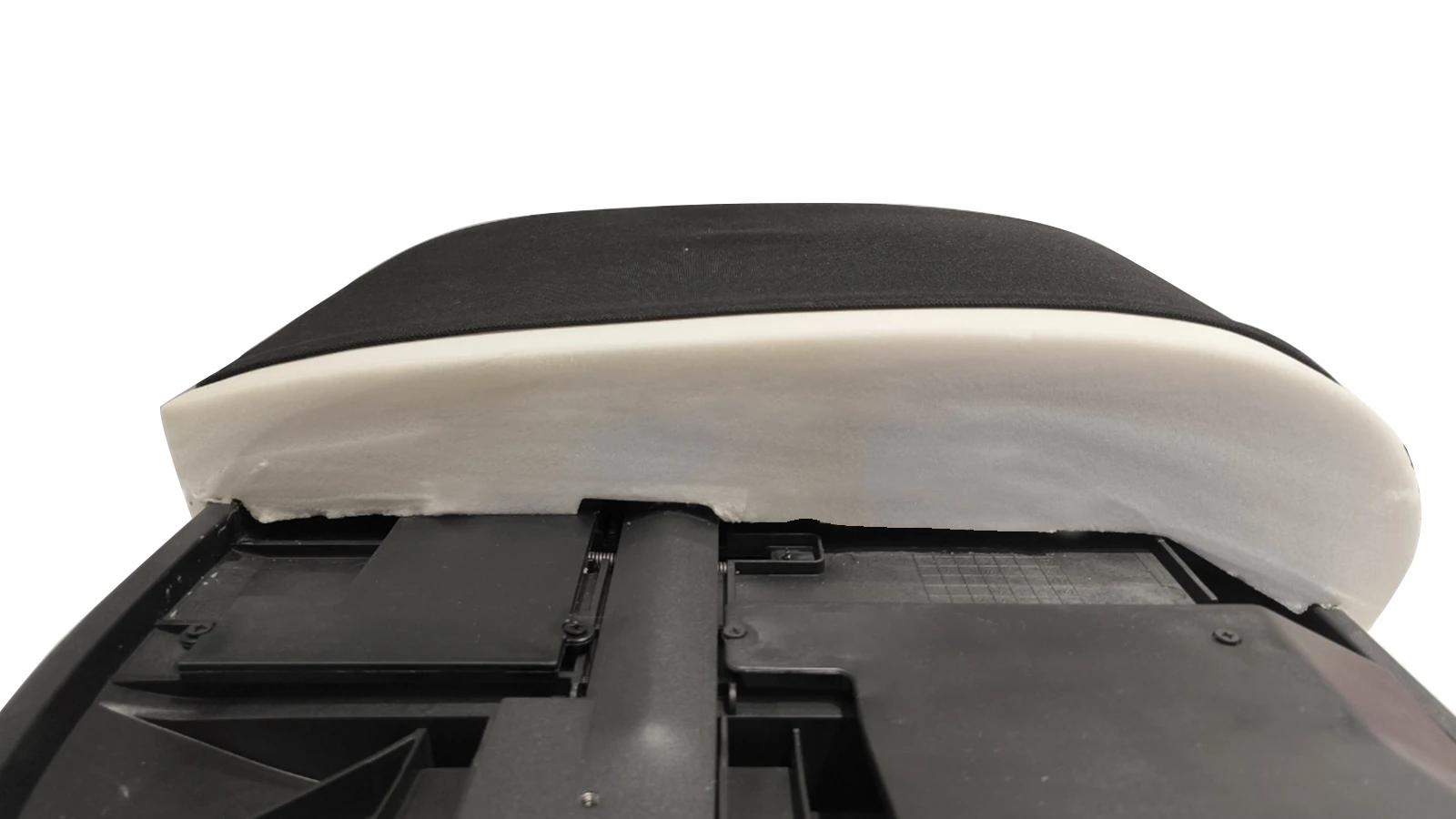
Quality seat cushions use molded foam at 50–65 kg/m³ density. Budget chairs typically use 25–35 kg/m³ foam — it feels fine on day one and bottoms out within six months. Once the foam compresses, you’re essentially sitting on plywood with fabric over it. That’s when back pain accelerates.
Base and Casters
A reinforced nylon or aluminum five-star base can handle 150,000+ tilt cycles. Cheap bases use recycled or low-grade nylon that becomes brittle over time, especially in air-conditioned environments where temperature cycling stresses the plastic. Base failure is the number one safety hazard in budget chairs — and a potential liability issue for employers.
Mechanism
The tilt mechanism is the heart of any office chair. Budget chairs use a simple butterfly mechanism with no tension adjustment. Mid-range and premium chairs use synchro-tilt or multi-function mechanisms that support natural movement throughout the day. Understanding office chair materials and their impact on durability is essential before making a bulk purchase decision.
The Procurement Mindset Shift: Total Cost of Ownership
The single most important change a company can make is to stop evaluating chairs by unit price and start evaluating them by cost per seated hour over the expected lifespan.
Here’s how the math works:
- Budget chair: $100 ÷ (1.5 years × 2,000 hours/year) = $0.033/hour. But add one replacement and one warranty claim, and the real cost jumps to $0.06–$0.10/hour.
- Quality ergonomic chair: $600 ÷ (10 years × 2,000 hours/year) = $0.03/hour. No replacements, no claims, lower sick-day risk.
The quality chair is literally cheaper per hour of use — before you even account for health benefits and productivity gains.
For Instance: A Corporate Facilities Team Gets It Right
A regional insurance company in Europe replaced 450 budget task chairs with commercial-grade ergonomic seating in 2024. Their facilities director tracked outcomes over 18 months: warranty claims dropped from 47 per quarter to 2, furniture-related maintenance requests fell 89%, and HR reported a 12% reduction in back-pain-related sick days. The payback period on the higher upfront investment? Fourteen months.
When evaluating what to prioritize, these 10 key factors should guide every purchasing decision.
Environmental and Disposal Costs Most Buyers Forget
Every cheap chair that breaks becomes waste. And waste has a cost — both financial and reputational.
Disposing of office furniture isn’t free. Commercial waste removal services charge $15–$50 per bulky item depending on location. If you’re cycling through 50 chairs a year, that’s $750–$2,500 annually just in disposal fees. Some municipalities require special handling for gas cylinders (they contain pressurized nitrogen), adding further cost and complexity.
Then there’s the ESG angle. Companies increasingly report on sustainability metrics. Sending hundreds of chairs to landfill every few years is the opposite of a circular economy. Quality chairs with longer lifespans, replaceable components, and recyclable materials align with corporate sustainability goals — and that matters to employees, investors, and clients who are paying attention.
Red Flags When Evaluating Office Chair Suppliers
Not every affordable chair is junk, and not every expensive chair is worth the money. Here’s how to separate genuine value from marketing fluff:
Warning Signs of a Chair That Won’t Last
- No published warranty terms — or warranty limited to 90 days / 1 year
- No BIFMA, EN 1335, or equivalent testing certification
- Foam density not disclosed — if they won’t tell you, it’s low
- Plastic mechanism housing instead of steel
- Non-replaceable gas cylinder — proprietary or welded in
- “Ergonomic” in the name but only height-adjustable — real ergonomic chairs offer lumbar depth, seat depth, armrest height/width/pivot, and tilt tension adjustment
Green Flags of a Chair Built to Last
- 10+ year warranty on structural components
- Published test results (cycle counts, weight ratings)
- Replaceable parts available for independent purchase
- Transparent material specifications (foam density, mesh denier, base material grade)
- Manufacturer willing to provide samples for extended trial
If you’re comparing ergonomic options against standard office chairs, understanding which types of ergonomic chairs to avoid is just as important as knowing what to buy.
Making the Business Case to Leadership
If you’re a facilities manager or office administrator reading this, you probably already know cheap chairs are a problem. The challenge is convincing the people who sign the purchase orders. Here’s how to frame the argument:
Speak in Their Language: ROI
Don’t lead with “employees deserve better chairs.” Lead with “we’re spending $X per year on chair replacements, warranty administration, and back-pain-related absenteeism. A one-time investment of $Y eliminates 80% of that recurring cost and pays for itself in [Z] months.”
Use a Pilot Program
Propose replacing chairs in one department or floor as a 6-month pilot. Track warranty claims, maintenance requests, and employee comfort surveys before and after. Hard data from your own office is more persuasive than any vendor’s brochure.
Quantify the Intangible
Employee satisfaction surveys consistently rank workspace comfort in the top five factors affecting job satisfaction. In competitive hiring markets, the quality of your office environment is a retention tool. A $500 chair that keeps a $75,000/year employee happy and healthy for a decade is not an expense — it’s one of the highest-ROI investments a company can make.
Stop Buying Chairs — Start Investing in Workstations
The cheapest chair you’ll ever buy is the last one you need to buy. That’s not a slogan — it’s accounting.
Every dollar spent on a disposable office chair gets spent again in 18 months. Every dollar spent on a properly engineered, certified, warranty-backed ergonomic chair works for you for a decade or more. The hidden costs — warranty claims, replacement logistics, disposal fees, administrative time, sick days, presenteeism, and employee dissatisfaction — add up to multiples of the original “savings.”
At Vaseat, we design and manufacture commercial-grade ergonomic seating built for exactly this kind of long-term value. Our chairs are tested to international standards, backed by comprehensive warranties, and engineered with replaceable components so they stay in service — not in a dumpster. If you’re ready to break the replacement cycle, learn more about how we work with businesses worldwide to solve exactly this problem.